
The Fight to Save Tacoma’s Disappearing Orcas
TACOMA, Wash. — Every June, communities across Washington, Oregon, and British Columbia gather for Orca Action Month, a grassroots effort dedicated to protecting the gravely endangered Southern Resident killer whales, or orcas, that have long symbolized the Pacific Northwest.
“Even though they live in a world that is in many ways so foreign to ours, thanks to decades of research, we know them as individuals and families,” said Monika Shields, Director of Orca Behavior Institute.
As Southern Resident orcas face mounting environmental pressures from polluted waters, declining salmon populations and ecosystem disruption, conservation groups and communities across the Pacific Northwest are intensifying their efforts to protect a species that has become both an ecological warning and a powerful symbol of regional identity.
Scientists say Southern Resident orcas are more than an endangered species — they are among the clearest indicators of the health of the Salish Sea. Because the whales sit at the top of the marine food web, their recovery reflects whether salmon populations, water quality and habitat restoration efforts are improving across the region. For cities like Tacoma, protecting the orcas is also a way of measuring whether decades of environmental investment are strengthening climate resilience.
Why the Whales are Disappearing
In 2005, U.S. federal agencies declared the species as endangered and worked towards recovery efforts. However, the population continued to decline in the decades since. As of today, only 73 Resident orcas remain.
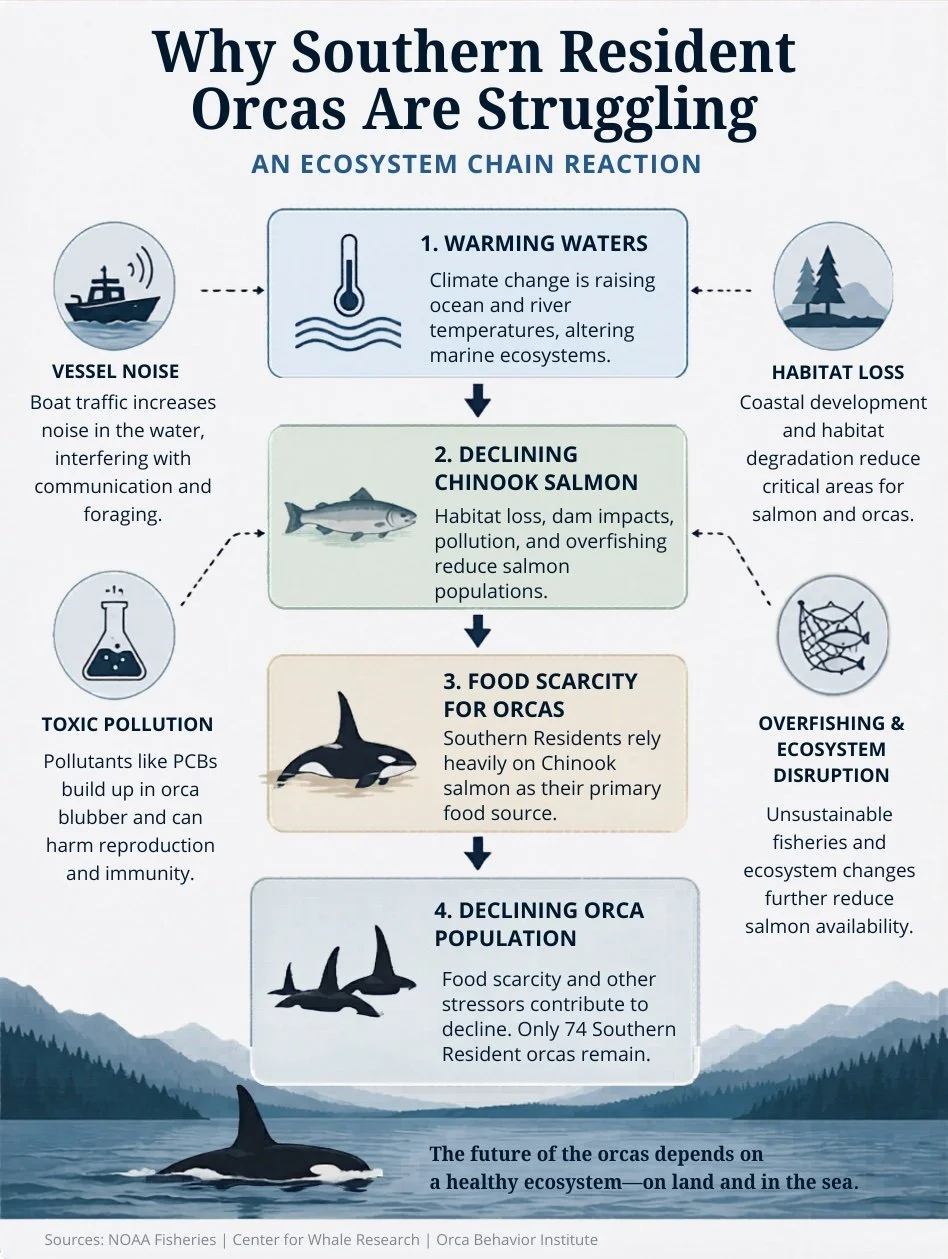
Fish-eating orcas rely heavily on Chinook salmon, comprising nearly 80% of their diet. However, due to pollution, Chinook salmon are on the brink of extinction.
With a declining population of prey, Resident orcas are unable to successfully reproduce and maintain their health. As of today, two-thirds of orca pregnancies fail due to nutritional stress.
“Southern Resident orca health is also directly impacted by toxic contamination, including legacy pollutants such as PCBs that accumulate in orca blubber,” said Gail Cabahug, policy and advocacy manager of Puget Soundkeeper.
Even though PCBs were banned by U.S. federal law in 1979, domestic manufacturing up to that point had released these chemicals into our air, water and soil. PCBs do not easily decompose and can remain in the environment for decades.
As these chemicals become more concentrated moving up the food chain — a process called biomagnification — apex predators like killer whales end up consuming more PCBs than any other sea mammal.
Exposure to PCBs can weaken immune systems, disrupt reproduction and contribute to disease in orcas.
“If they can't thrive, whatever is affecting them is probably affecting many other species too,” said Shields.
Scientists often describe apex predators as indicators of ecosystem health because they accumulate the effects of changes occurring throughout the food web. If Southern Resident orcas struggle to survive, it signals broader problems affecting salmon, marine habitats and the waters that support communities throughout Puget Sound.
The Fight to Save Them
The Orca Salmon Alliance (OSA) — a coalition of environmental conservation — has worked together with local non-profits and research organizations from the Pacific Northwest to proclaim June as Orca Action Month. From beach clean-ups to public advocacy campaigns, this month of conservation rallies communities to participate in education initiatives and hands-on rehabilitation work to prevent the extinction of Southern Resident orcas and Chinook salmon.
Puget Soundkeeper, a local grassroots organization and prominent member of Orca Action Month, has a mission to monitor water quality, help set strong policies through civic engagement and educate the public in local water pollution issues.
Cabahug said growing threats to Southern Resident orcas are being compounded with efforts to weaken environmental protections across the region.
“Policies and protections must reflect the urgency and severity of these declining populations,” said Cabahug.
An example is the modification of the Endangered Species Act (ESA) — one of the nation’s strongest conservation protection laws. In April 2025, federal agencies overturned the legal definition of “harm,” a deeply rooted interpretation that has allowed habitat destruction and poaching of endangered animals to be treated as a violation of the ESA.
The definition, upheld by the Supreme Court in 1995, has played a vital role in protecting vulnerable wildlife by preventing activities that compromise essential ecosystem functions. Conversation groups argue this change weakens protections for Southern Resident orcas, Chinook salmon and countless other endangered species by making it more difficult to address habitat loss and animal cruelty.
“We need to use our voices, and our votes, to tell elected officials that enough is enough and we demand real action to protect these amazing animals from extinction,” said OSA in a recent press release.
Orca Behavior Institute (OBI), a non-profit organization, collects behavioral data of Resident orcas to gain perspective on their travel patterns and habitat usage.
Monika Shields, Director of OBI, said conservation efforts such as salmon habitat restoration, Lower Snake River dam breaching and proposals to ban harmful chemicals could significantly improve recovery outcomes for Southern Resident orcas.
“We need all aspects of their environment and all aspects of the food web to be functioning in a healthy, sustainable manner for the Southern Residents to recover,” said Shields.
Tacoma’s Role in Recovery
While much of the effort to protect Southern Resident orcas has focused on marine protections and salmon recovery, Tacoma officials say revitalization often comes down to improving water quality closer to residential areas.
Dana DeLeon, assistant division manager for Tacoma’s Environmental Services Department, said stormwater management plays a vital role in protecting the Salish Sea ecosystem.
Those investments are designed to do more than reduce pollution. By restoring the ecological conditions that orcas and salmon rely on, they also provide a way to gauge whether the city’s climate resilience efforts are improving the health of a broader marine ecosystem.
"Only 12% of Tacoma's stormwater is treated before it reaches our waterways,” said DeLeon.
Yet, stormwater runoff from roofs, streets and parking lots often contain oil, pesticides and fertilizers such as rubber-tire additives and PCBs — leading to waterborne diseases and harmful algal blooms.
To address these threats, Tacoma has expanded its stormwater management efforts through watershed planning, business inspections, oil spill response and long-term water quality monitoring.
Through the Stormwater Management Program, city staff work to identify pollution sources before contaminants reach local waterways.
According to the city's Environmental Services Department, the city responded to 192 spills in 2024 and conducted business inspections, source control investigations, and spill response activities within the Foss Waterway watershed alone.
DeLeon said Tacoma's efforts build upon decades of restoration work at Thea Foss Waterway, a former Superfund into which more than $100 million has been invested in cleanup efforts to reduce contamination and protect marine ecosystems.
Over the past 24 years, city staff collected more than 2,500 stormwater and sediment samples to track pollution entering local waterways. As a result, city monitoring data has shown significant reductions in pollutants including lead, zinc and polycyclic aromatic hydrocarbons (PAHs).
A Symbol of the Pacific Northwest
Tacoma’s relationship to the killer whale is rooted in history. Coastal Salish Tribes, specifically the Puyallup Tribe, have shown deep veneration for Resident orcas since the founding of the city.
“For Washington tribes, killer whales are regarded as family, with deep cultural and spiritual ties that span generations,” said Cabahug.
The Puyallup Tribe works in collaboration with the University of Washington and non-profits like Water Warriors to monitor and study native waters, oil spills and advocate for policy protections that dismantle industrial projects harmful to the regional marine ecosystem.
“We can make a difference by using our votes to be a voice for marine species that cannot speak up for themselves,” said OSA in a recent press release.
Despite growing efforts, uncertainties still remain as to whether recovery efforts can move quickly enough to match the environmental pressures facing the Southern Resident orcas. This fight is held close to the heart of Tacoma, as communities are trying to protect something that is irreplaceable.
“We share these waters with them, yet it is us (humans) who have damaged their home,” said Cabahug.
The recovery of Southern Resident orcas has never simply been about saving one endangered species. Because the whales depend on nearly every part of the marine food web functioning properly, they have become one of the clearest indicators of whether restoration efforts are rebuilding a healthier Salish Sea — one capable of supporting fisheries, tribal resources, tourism and waterfront economies.
For Tacoma, the Salish Sea is more than a backdrop — it is part of the city's identity. Its waters support recreation, local businesses, tribal traditions and the ecosystems that have sustained communities for generations. As Tacoma continues investing in cleaner waterways and healthier habitats, officials hope those efforts will benefit far more than a single species. The future of the Southern Resident orcas may ultimately become one measure of whether the Salish Sea itself is recovering.
*Cover image courtesy of NOAA Fisheries