
Climate Change and Rapid Growth Narrows the Range of River Management Options in Northern Colorado
As the summer heat settles over Fort Collins, residents gravitate toward the Cache la Poudre River. Some come to fish, some to float down in their inflatable tube or kayak, and others simply to wade through the crisp running water.
The Cache la Poudre River flows 126 miles from Rocky Mountain National Park through the Front Range in Northern Colorado, making it a hub for outdoor recreation in Fort Collins, the largest city in the Cache la Poudre River Watershed.
Few people know the river better than Ellen Wohl, a fluvial geomorphologist and professor of geosciences at Colorado State University. She has spent decades studying how rivers like the Poudre shape landscapes and ecosystems, from channel morphology and sediment transport to hydrology.
“Any river can be an asset in an urban or metropolitan area, or it can be a liability,” Wohl said. “We can treat it as an irrigation canal, or we can treat it as an ecosystem that we can continue to enhance with our activities rather than damage.”
As Northern Colorado's population grows and drought tightens water supplies, Fort Collins faces a difficult decision: whether to prioritize water storage or the health of the river. The City is weighing whether to participate in Northern Water's Glade Reservoir project or expand the existing Halligan Reservoir, forcing leaders to consider how much ecological change they are willing to accept in exchange for greater water security through 2065. Northern Water expects Fort Collins to decide by the end of the year.
Climate change and rapid growth are narrowing the range of sustainable options in the West, and policymakers must weigh competing environmental tradeoffs even more.
Colorado depends heavily on mountain snowpack, which melts each spring and replenishes rivers. The Cache la Poudre reaches its highest flows around mid-June before returning to a lower, groundwater-fed base flow for the rest of the year. Diversion dams redirect water from the river to be stored in reservoirs for agricultural, municipal, industrial, and recreational purposes.
This year, Colorado experienced a statewide drought and a historically low snowpack across many watersheds. As temperatures continue to rise, snowpack is expected to shrink and melt earlier in the spring, leaving less water to feed the Cache la Poudre River during the dry summer months.
Satellite images of the western U.S. in 2012 and 2026, showing recent snowpack deficits (NASA Earth Observatory).
At the same time, demand for that water is increasing. Between 2010 and 2020, Colorado's population grew at nearly twice the national rate, making it one of the fastest-growing states in the country, according to the U.S. Census Bureau. As more people move to the Front Range, competition for water intensifies, increasing the need to store enough water to meet agricultural and municipal demands.
That is why conserving and storing every bit of water is so important, according to Jeff Stahla, public information officer at Northern Water. Over the last 150 years, Colorado has developed processes to re-time the snow runoff through the construction of reservoirs to optimize water supply for the warmer weather season. Northern Water’s Northern Integrated Supply Project (NISP) plans to construct the Glade Reservoir, which will divert water out of the Poudre River to store in a dry valley.
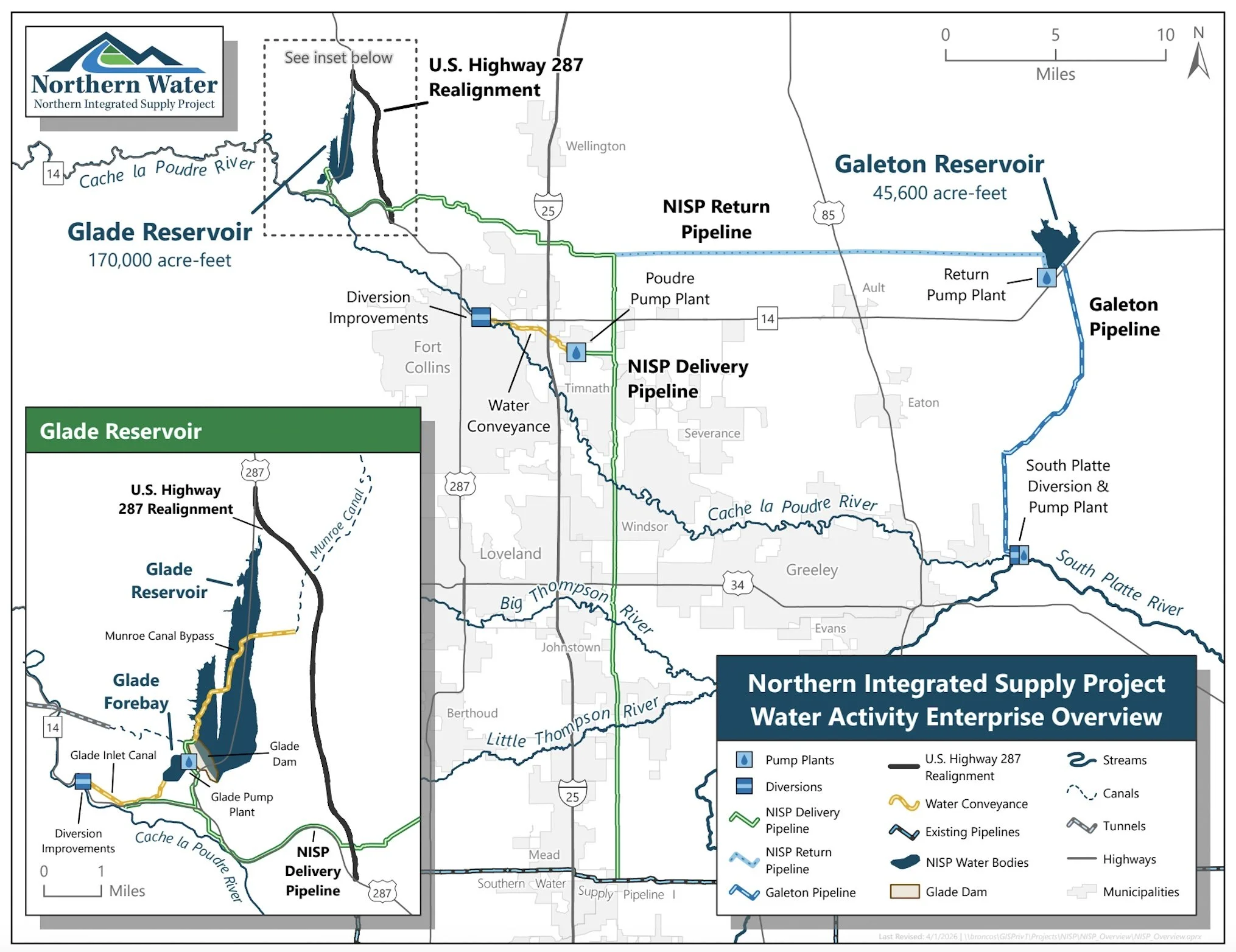
Map of plans for the Northern Integrated Supply Project. Courtesy of Northern Water. Accessed at 1:30 pm on July 14, 2026. © 2026 Northern Colorado Water Conservancy District. All rights reserved.
“People are still just surging here in Colorado. It's a project about helping to meet the needs of a growing population here on the Front Range of Colorado,” Stahla said. “We save every drop that we get, and we need to be using it as efficiently as possible.”
Some locals like Wohl are hesitant to support NISP because of the potential environmental impacts diversions would have on the Cache la Poudre River, including irregular flow variability and biodiversity.
She said the Cache la Poudre is already overappropriated, meaning more water has been legally allocated to users than the river can reliably provide in many years. Because the Glade depends on unusually high runoff years — which climate change is making less frequent — she worries the project would further reduce the high spring flows that sustain the river's ecology.
“It would further compromise the river's ability to have any high flows, which are critical for maintaining channel configuration, but also for anything that lives in the river, from aquatic insects to fish to plants,” Wohl said.
Stahla maintains that Northern Water has prioritized ecological resources through an extensive federal permitting process.
“The net impact of the project is actually going to be to improve river flows over the course of the year,” he said. “Water only becomes collectible during the highest runoff times for the river. And so, that really limits the impact of reduced flow in the river to a couple of months out of the year.”
Under Northern Water's plan, Glade Reservoir would release stored water back into the Poudre for much of the year, increasing flows outside of spring runoff. The project would primarily reduce flows during the highest runoff months, when excess water would be diverted into storage.
Wohl questions whether altering the river's natural flow pattern could have unintended ecological consequences. She also worries about the reservoir's design. Unlike a natural reservoir formed by a river, Glade would store water in a broad, shallow dry valley, increasing evaporation in Colorado's hot, dry climate.
“That reservoir would have a very broad surface area and fairly shallow depth, so that just maximizes evaporative loss in our dry, sunny climate,” Wohl said. “A lot of the time you'd have either huge dry margins or the whole thing would be dry. That's a great place for a source of dust when we have winds.”
The disagreement ultimately comes down to different visions for the river. Northern Water argues Glade includes measures to reduce environmental impacts, including fish passage structures and managed downstream releases. Wohl and other conservation advocates believe the project would alter the very ecological processes Fort Collins has spent decades trying to restore.
The city has invested millions of dollars in reconnecting the Poudre with its floodplain and restoring habitat. Wohl worries that additional diversion dams could sabotage those efforts because they would risk that connectivity.
Additionally, the Glade portion of NISP is expected to cost roughly $2 billion, shared among participating communities. Fort Collins is also considering expanding Halligan Reservoir, a project estimated to cost about $300 million, as an alternative to the Glade Reservoir.
Wohl considers Halligan "a better alternative than Glade" because its deep, narrow valley would reduce evaporative losses, though she emphasizes it is "not perfect."
Save the Poudre, a local nonprofit focused on protecting and restoring the river, sued Northern Water in 2024 to challenge NISP's federal permits. The lawsuit ended in 2025 with a settlement directing $100,000 toward river restoration.
Though the organization prefers NISP to the Halligan expansion, it argues that many of Northern Colorado's future water needs could be met through stronger conservation measures instead of building or expanding reservoirs. It proposed tiered water pricing, public education, rebates for water-efficient appliances and landscaping, improved irrigation practices, expanded gray-water recycling, and greater efficiency in agricultural water use.
Whether those measures will be enough remains the central question. As climate change reduces the snowmelt feeding the Cache la Poudre and more people depend on its water, Fort Collins must decide not whether change is coming, but which compromises it is willing to make.