Regional Collaboration is the Backbone of Mystic Watershed’s Climate Fight
When Nasser Brahim and his wife were looking for a home in Squantum, a low-lying coastal neighborhood in Quincy, Massachusetts, they prioritized houses that sat well above projected flood zones.
"I specifically made sure we were buying well out of the flood zone," Brahim said. "But I always joked—but not really fully joking—that we'd need to invest in a kayak and a generator."
A causeway connects the Squantum Peninsula through a marsh that has flooded repeatedly during the nine years Brahim has lived there. These coastlines are especially vulnerable to flooding as climate change brings sea level rise and more extreme weather events occur. For Brahim, director of climate resilience at the Mystic River Watershed Association (MyRWA), his experience buying a home informs his work across Greater Boston to “protect people and places from climate-intensified risks.”
The Mystic Watershed does not have a county government to coordinate regional work. To fill that gap, the Mystic River Watershed Association created the Resilient Mystic Collaborative (RMC), bringing together 20 municipalities to address stormwater flooding, extreme heat and coastal flooding.
“The Resilient Mystic Collaborative brings people together to deal with a common issue across boundaries, and share resources in a way that wouldn't otherwise happen because we lack that level of governance in Massachusetts,” said Brahim.
By forming the collaborative, municipalities are able to learn from each other and with each other to create climate-resilient infrastructure that elevates their shared priorities. Because climate systems and watersheds extend far beyond city limits, decisions made in one community inevitably affect its neighbors.
“Individual communities don't have control of their climate resilience destiny because a lot of the things that need to happen are somewhere else,” he said. "What happens upstream affects risks downstream, and what happens downstream affects risks upstream.
Stormwater Flooding
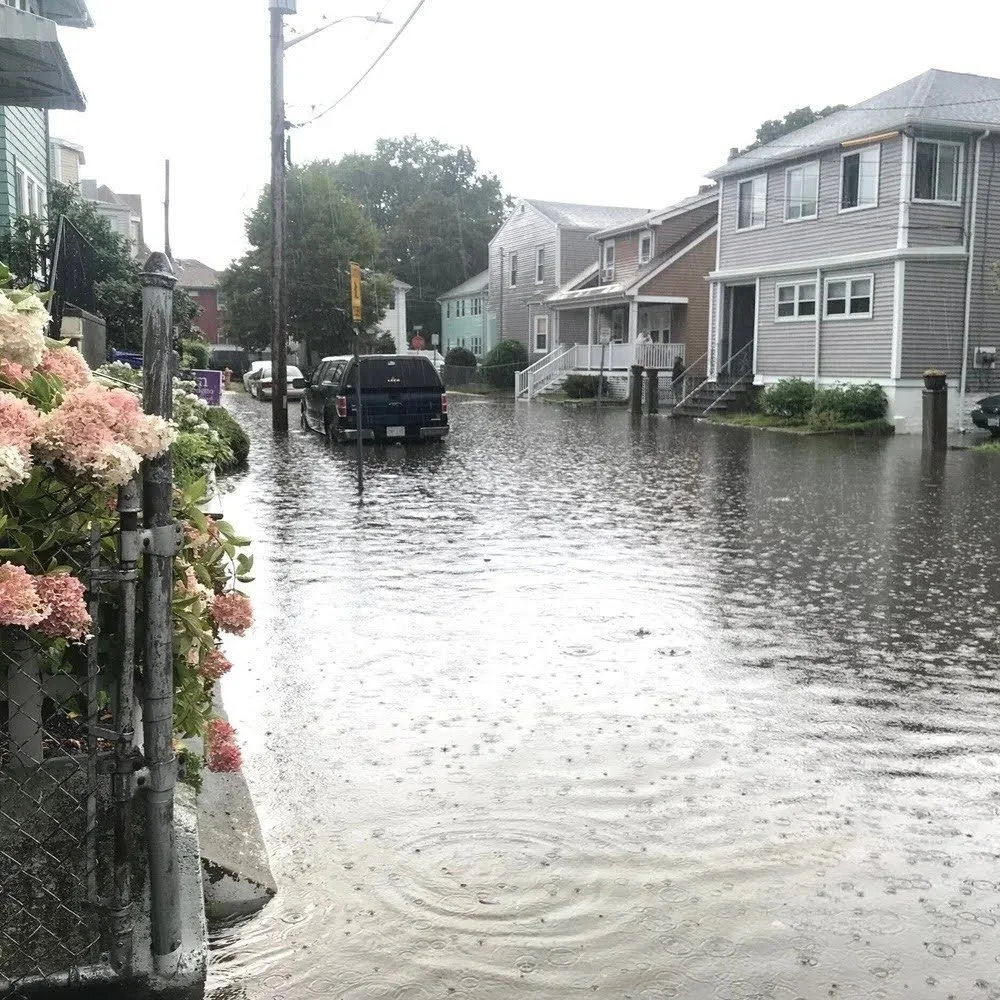
Stormwater flooding in a Mystic Watershed neighborhood. Photo by the Resilient Mystic Collaborative. Courtesy of Catherine Pedemonti.
Senior climate resilience manager at the Resilient Mystic Collaborative, Catherine Pedemonti, shared the type of conversation she facilitates in RMC’s stormwater-flooding working group.
This group encourages conversations across municipalities to think about expanding local programs to the entire Mystic Watershed. “For example, Cambridge, their policy tends to be very forward-facing and very progressive,” she said. “We would hold meetings where we would invite Cambridge and ask: ‘What does your flood-resilient policy look like, and more importantly, how did you get there?”
“This helps other cities and towns think about how they might also get there,” she added.
RMC used Cambridge’s hydrologic and hydraulic climate (H&H) hazard model to simulate flooding across the watershed, upscaling Cambridge’s strong local initiative to the regional level.
After realizing that preventing stormwater flooding in Mystic Watershed communities altogether was unrealistic, the working group turned to focus on preventing flood damage in those areas identified through the H&H model.
RMC began identifying locations for large-scale constructed wetlands that could regionally hold floodwaters during the onset of a destructive storm. Six sites moved into the design process, where they worked closely with local community-based organizations and community members to understand their needs and priorities. One constructed wetland is already complete.
Now, much of the stormwater flooding working group’s focus is on policy changes to increase state funding for stormwater infrastructure and reconsider zoning regulations. The group hopes those changes will make it easier for municipalities to coordinate projects across city lines.
“Each city or town is not prioritizing within their borders,” Pedemonti said. “It's looking regionally.”
Coastal Flooding
As sea levels rise and storm surges become more severe, coastal flooding has emerged as one of the Mystic region's most pressing challenges. Dense neighborhoods and critical infrastructure built on former wetlands are increasingly vulnerable — additional factors that push municipalities to think beyond their own borders.
“We built this ethos of regional concerns, regional priorities, and that started really with our coastal flood concerns,” said Brahim, who serves as the facilitator of the Coastal Flooding working group in addition to his leadership in MyRWA.
The region's two primary flood control structures, the Amelia Earhart and Charles River Dams, were built to protect nine upstream communities from coastal storm surges. But within the next 10 to 20 years, rising seas are expected to allow floodwaters to overtop or bypass the dams during major storms, threatening the level of protection they were originally designed to provide.
The Resilient Mystic Collaborative (RMC) is focusing on coastal flood pathways, the low-lying routes that allow floodwaters to surge inland. Relying on equity-centered research and community feedback, RMC identified seven priority coastal flood pathway sites across the Mystic Watershed, along with improvements at both dams. The collaborative prioritized neighborhoods and critical infrastructure most vulnerable to flooding, and began to design projects that provide desired community benefits, including waterfront access and public infrastructure.
One priority project is to upgrade the Amelia Earhart Dam. The Department of Conservation and Recreation (DCR) owns both the Amelia Earhart Dam and the adjacent Draw Seven Park, which contains one of the region's most significant coastal flood pathways. During severe storms, floodwaters can move around the dam through the low-lying park and into surrounding communities.
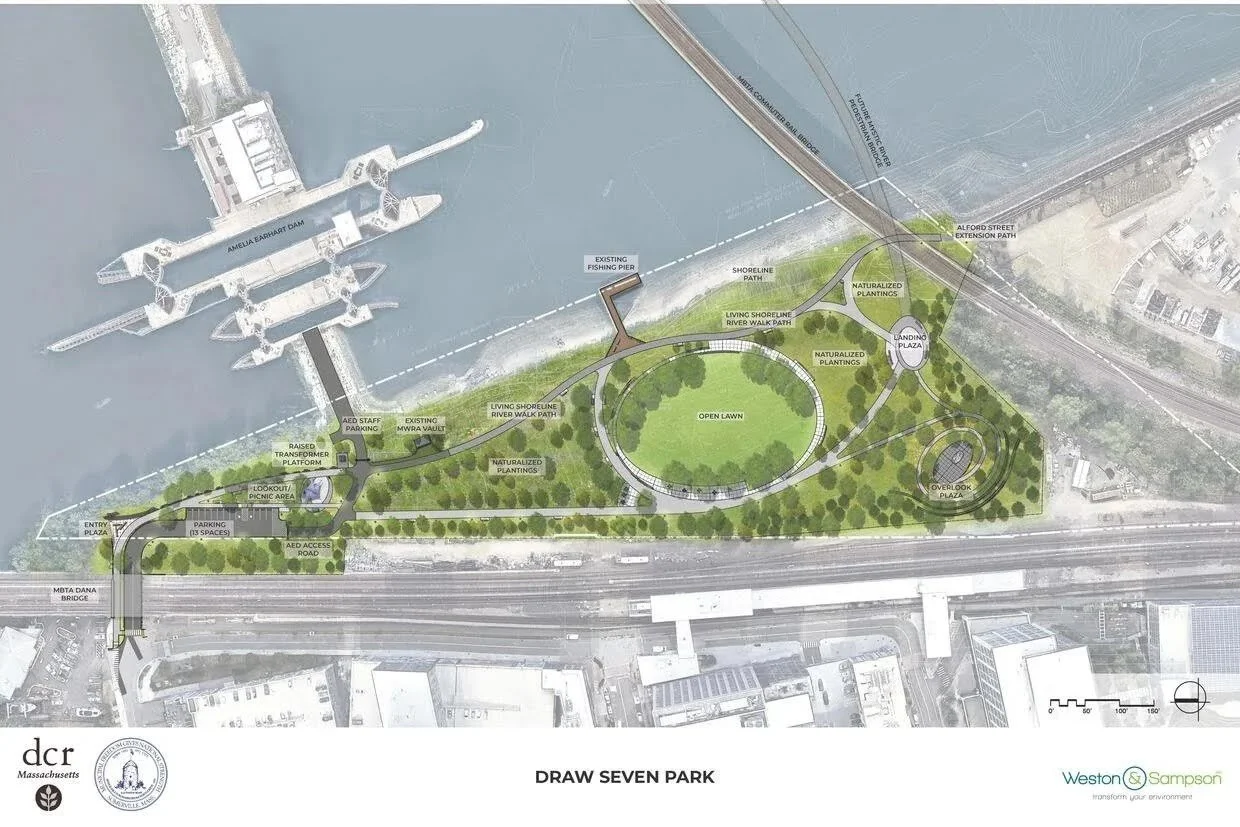
Map of Amelia Earhart Dam and adjacent Draw Seven Park. Image by Weston & Sampson. Courtesy of Catherine Pedemonti.
Because municipalities did not own the infrastructure, they could not address the problem independently. Instead, the Massachusetts Coast Flood Risk Model (MC-FRM) gave communities a shared understanding of the regional threat and helped unite them around a common solution.
RMC coordinated municipalities to advocate through the state legislature for earmarks and funding to move the Draw Seven Park project forward. Through this collaboration, the municipalities successfully secured support for a hidden levee and resilient shoreline upgrades, which are expected to be completed in fall 2026. Those improvements will work alongside planned upgrades to raise and strengthen the Amelia Earhart Dam.
Brahim said Draw Seven Park became the first example of regional collaboration translating into tangible coastal flood protection for the Mystic Watershed.
"It will solve the coastal flooding issue for, at least parts of, seven different municipalities for generations."
Extreme Heat
By 2070, Greater Boston is expected to experience up to 46 days above 90 degrees per year, an increase from historical trends.
“It's called a silent killer for a reason. It's less obvious visually than a hurricane or an earthquake, but it's something that slowly affects the health of people without even noticing,” said Mariangeli Echevarria-Ramos, climate and social resilience manager for the Mystic River Watershed Association.
In 2021, the collaborative launched Wicked Hot Mystic, a community science campaign that enlisted 80 volunteer scientists to collect air temperature and air quality data during a 24-hour extreme heat event. The data was used to create maps identifying neighborhoods with the highest temperatures and poorest air quality.
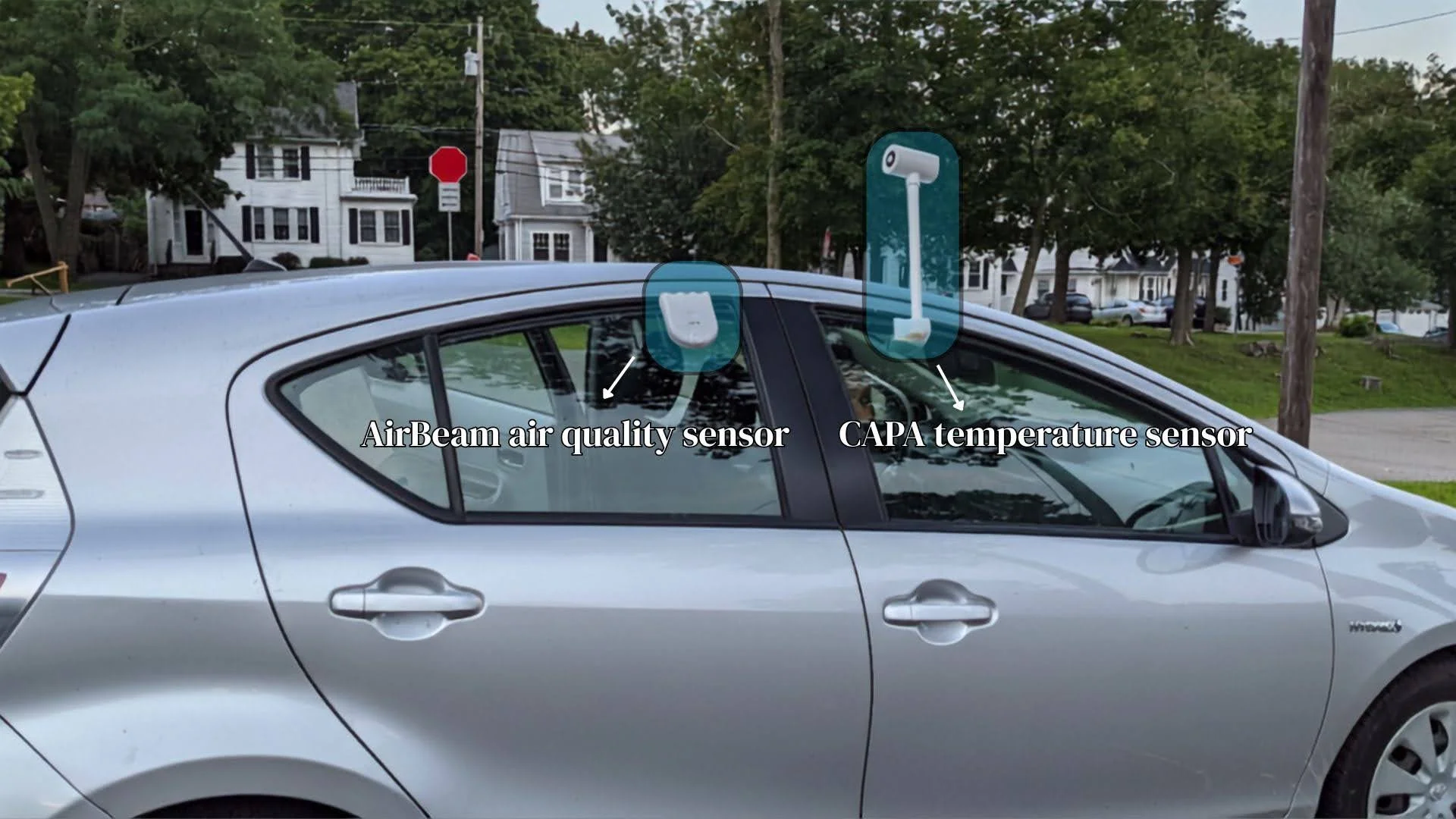
Sensors mounted on cars of community volunteers during Wicked Hot Mystic data collection. Photo by the Resilient Mystic Collaborative. Edited by Sarah Brown. Courtesy of Catherine Pedemonti.
Again, rather than each municipality tackling the problem independently, the collaborative used those findings to coordinate a regional response.
“We shouldn't be reinventing the wheel in every municipality,” she said. “We can unify forces and share resources to be able to walk towards the same goal.”
This culminated in a follow-up initiative, Wicked Cool Mystic, which focused on Chelsea, Everett, Malden and Arlington — some of the hottest communities identified from the data collection. Two community ambassadors from each municipality led conversations with residents to better understand local needs and priorities.
Those conversations shaped several community-driven heat resilience initiatives, including adding shade structures, trees, water fountains and splash features, improving extreme heat communications and strengthening libraries, churches and other community centers to serve as cooling hubs during emergencies.
“Everyone is very transient in their day-to-day, and we will hope that working regionally — if people are moving all across the watershed all the time — that no matter where you go, you will still find those interventions to help you cope with extreme heat,” Echevarria-Ramos said.
The collaborative continues pushing for additional long-term policy changes. It is advocating for updates to Massachusetts' sanitary code that would require landlords to provide cooling protections during periods of extreme heat, similar to existing winter heating requirements. At the same time, it continues expanding tree canopy throughout the watershed by planting trees in parks and on private property through partnerships with local organizations while training community tree ambassadors to help plant and maintain them.
Moving forward, RMC’s efforts will turn regional advocacy into action by learning from each other, coordinating around issues that cross county lines, and relying on community action to drive change.
"I'm not the first to say that climate change doesn't respect political boundaries, but it's true in the Mystic," Nasser Brahim said. "It can only really be mitigated by doing something in another city or town."
*Cover Image Courtesy of the Resilient Mystic Collaborative.