
How Boulder is Tackling Climate Goals without Compromising on Housing
BOULDER, Colo. — Boulder has spent decades building a national reputation for sustainable urban living, pouring resources into bike infrastructure and public transit to meet long-term emissions-reduction goals. Yet, as the cost of living continues to climb, tens of thousands of workers now commute into the city each day — a pattern some officials and housing advocates say may be undermining the city’s long-term environmental sustainability.
Boulder City Council Member Ryan Schuchard takes pride in the city’s stable rating among the nation’s most bike-friendly communities, with more than 300 miles of designated bike paths and walkable routes throughout the city.
Before being elected to City Council in 2023, Ryan served on Boulder’s Transportation Advisory Board (TAB), where he helped advance bikeway expansion, parking reform and new e-bike incentive programs. His candidacy drew support from national climate organizations like Run On Climate, who felt if elected Schuchard could make Boulder a nation-leading city in cutting emissions from transportation — the leading source of climate pollution in the U.S.
In his quest to make Boulder a national leader, efficient transit routes are top of mind for Schuchard.
“The most important thing about transit is that it’s frequent — and that’s supported by people living closer together,” he said.
But, as housing costs continue rising, many workers can no longer afford to live near Boulder’s transit systems, bike infrastructure and walkable neighborhoods. Urban planners and housing advocates say this growing affordability gap is contributing to longer commutes, heavier car dependency and increased transportation-related emissions.
With housing expenses outpacing local salaries, the growing number of Boulder employees now live in nearby communities such as Longmont, Louisville and Broomfield, commuting to the city each day for work. While Boulder continues investing in sustainable transportation systems aimed to reduce car dependency, skeptics warn the city’s affordability crisis is making future climate goals increasingly out of reach.
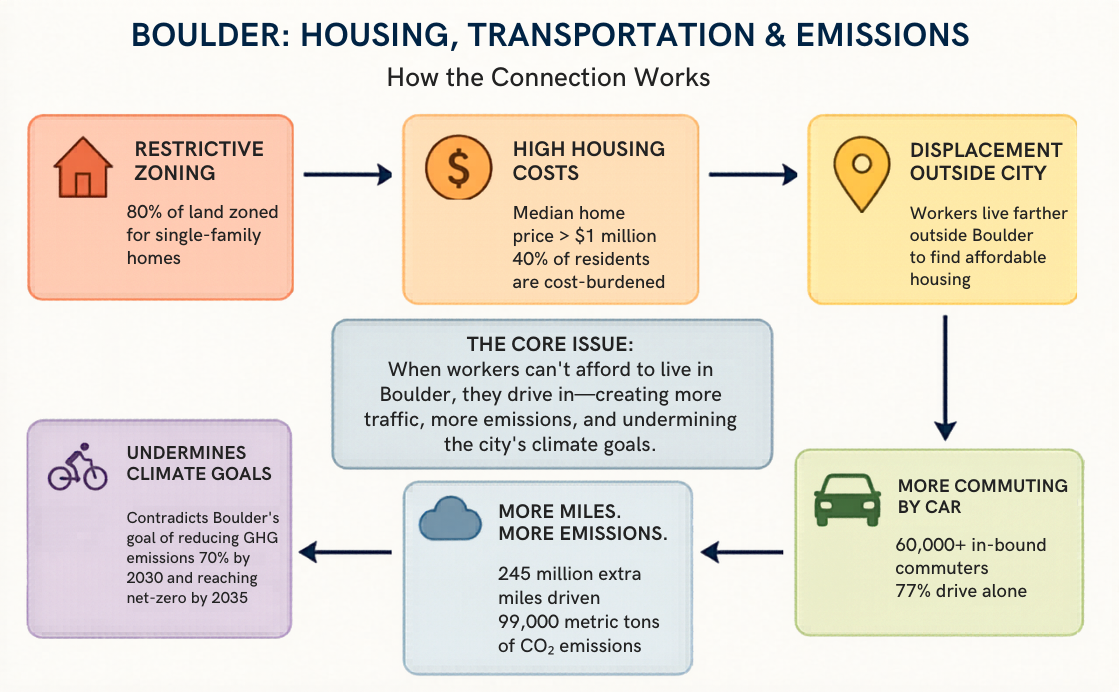
Boulder housing versus transportation relationship flow chart graphic. Courtesy of Avery Ehrig.
With four times as many jobs as houses being added to Boulder every year, many people work in Boulder but can’t keep up with the skewed supply and demand of the housing market. Because Boulder is the most expensive city in Colorado, a staggering 40% of residents are cost-burdened, dedicating over 30% of their annual income just to keep a roof over their heads.
With over 60,000 in-bound commuters entering the city every day, an additional 245 million miles are driven annually. Researchers estimate this commuter displacement contributes roughly 99,000 metric tons of CO2 emissions annually.
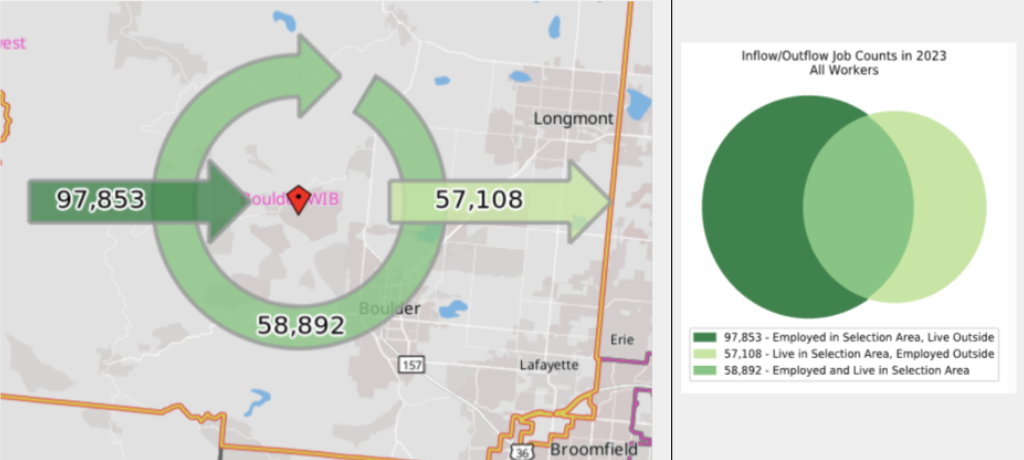
Worker Flows In, Out, and Within Boulder WIB. Courtesy of U.S. Census LEHD-Origin Destination Data, 2022.
Housing advocates and planners point to zoning laws as both the problem and the solution. Boulder’s Land-Use Policy restricts the number and types of homes that can be built, posing significant barriers to Boulder achieving housing affordability and environmental sustainability.
According to Boulder.Earth, a climate non-profit which focuses on sustainable and ecological landscape design, only 1 in 5 households comprise a nuclear family, yet 80% of zoning is specifically dedicated to them, impeding dense development.
Since joining City Council, Schuchard has supported zoning reforms designed to increase housing density by expanding duplexes, triplexes and other “middle housing” options throughout the city.
“I don't think a city with 100,000 residents and over 60,000 commuting each day is a pattern compatible with a climate-resilient city,” said Schuchard.
To encourage the use of public transit and reduce regional car dependency, Schuchard and his colleagues on Boulder City Council intend to implement a Transportation Master Plan, including the development of a multimodal system. This infrastructure will include racks on buses and safe walkways to bus stops. This grants residents the ability to switch between transit modes seamlessly without significant delays, ultimately reducing car dependency.
In addition, Boulder aims to address regional transport outside the city’s boundaries. This includes increasing accessibility and focusing on climate equity by offering new bus routes and protected bike lanes alongside highways.
In addressing these policies, Schuchard mentioned the city is working toward “15-minute neighborhoods,” where residents can more easily walk, bike, or take transit to work, school, or other daily activities.
These reforms will aid in meeting the goals of Boulder’s Climate Action Plan, including climate-specific initiatives intended to meet the standards of mitigation, resilience and equity. The plan aims to reduce 70% of greenhouse gas emissions by 2030, achieve net-zero emissions by 2035 and work towards carbon-positive living.
Schuchard said many of Boulder’s transportation and climate goals ultimately depend on allowing more residents to live closer to where they work, shop and access daily necessities.
“If you can’t afford housing, you tend to go outside of town looking for something cheaper,” Schuchard said. “But if you do that, then that increases your transportation cost.”
For Schuchard, the broader issue extends beyond climate policy alone. He said reducing car dependency and creating more walkable, transit-oriented communities would improve everyday quality of life regardless of emissions goals.
“The things we need to do to build a more climate-compatible world are things that just make life better anyway,” Schuchard said.