With FEMA Shrinking, what can Wildfire-Prone Communities do? Santa Barbara might have an answer
In December 2017, the Thomas fire blazed through Santa Barbara and became the largest wildfire in California history. It took over a month for the flames to be fully contained. Santa Barbara residents, government officials, and fire management were overwhelmed by the size and tenacity of Thomas. Today, only eight years later, Thomas ranks 9th.
Between 1980 and 2024, California has had the most billion-dollar wildfire disasters of any state in the U.S. In January 2025, Los Angeles endured the most destruction ever inflicted on the city by a string of sequential wildfires. While emotional and societal impacts of wildfires are immeasurable, damage to infrastructure and community-wide operations are often quantified to describe a fire’s severity and determine the funding they receive from the federal government.
The Federal Emergency Management Agency (FEMA) was enacted in 1979 as a means to aid in both disaster preparedness and relief through monetary and educational resources through the Disaster Relief Fund (DRF). Aid can take many forms, including but not limited to, water and meal deliveries, emergency shelter formation, and logistical support.
However, FEMA and this history of streamlined support is at risk. President Trump has told states to start weaning off of federal funding despite warnings from emergency management officials of fragmented power and insufficient state funding. According to the Fiscal Year 2026 Budget, the Trump administration diverted $625 million in FEMA funding to cities hosting the FIFA World Cup this coming summer. This is equivalent to the average cost of damages to over 4,000 homes in California as of 2025.
“The challenge is that local governments are strained in so many other ways that it's hard to build up those reserves, and so it is something that we have to proactively plan for,” Santa Barbara City Councilor Eric Friedman said.
Santa Barbara, like many other Californian cities, is uniquely positioned on the wildland urban interface, or the WUI, meaning despite being in an urban area, households are at greater risk due to proximity to wildlands.
Certain neighborhoods are at higher risk than others.
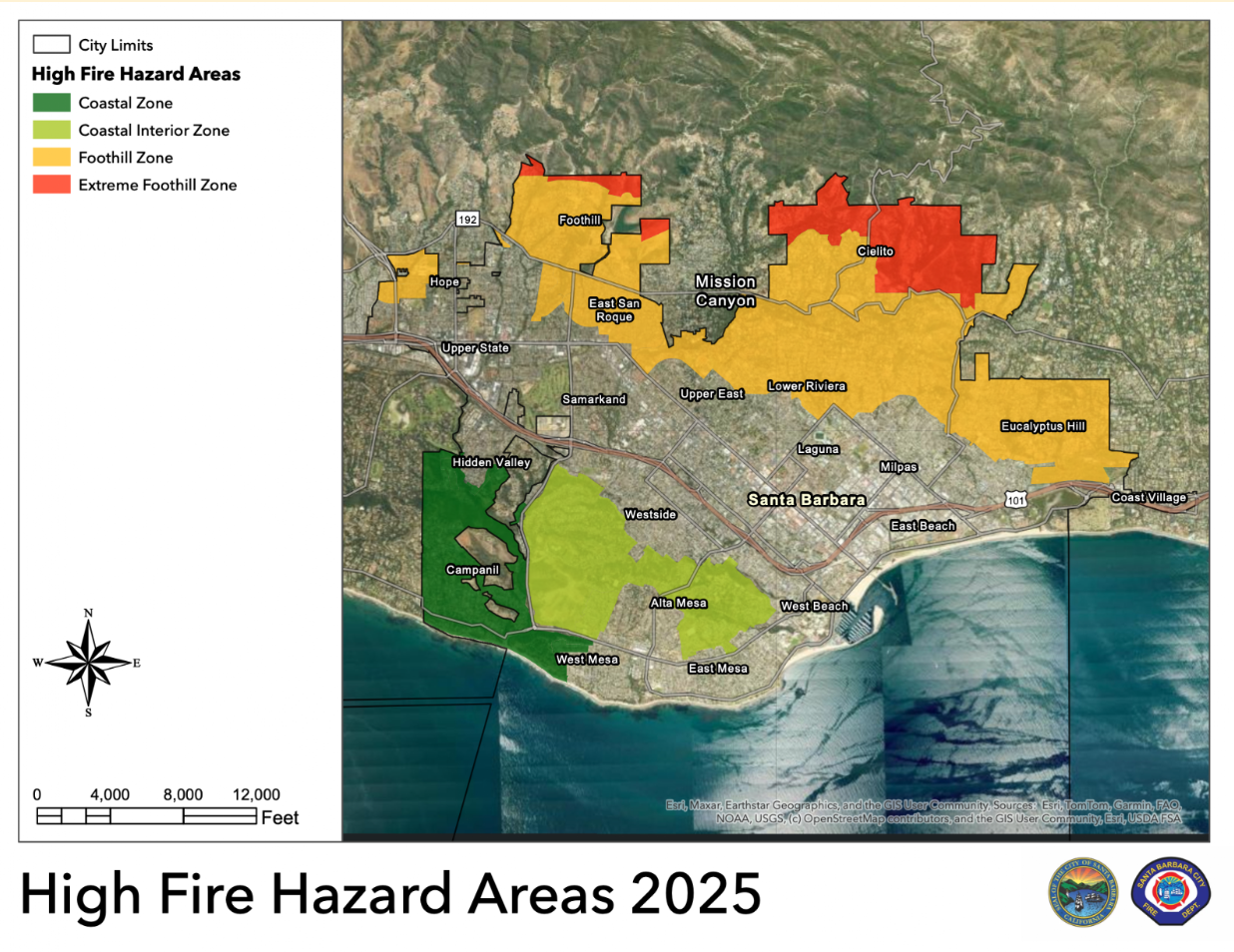
Courtesy of the Santa Barbara City Fire Department
These residents are taking initiative to raise the funds to protect themselves.
In July 2006, almost 4,000 households within the high fire hazard zone voted to create something called a benefit assessment district. Sometimes called special assessment districts, and in this case, Wildland Fire Suppression Assessment Districts (WFSAD), elected to tax themselves to build up a local government fund for fire management.
Benefits of being part of a WFSAD include roadside clearance, vegetation management, and access to informational resources on local implications of wildfires. Residents in any of the highlighted areas in the hazard map benefit from these services.
The city also offers free home evaluations to assess individual properties’ fire safety.
“We're not there to tell you to remodel your whole home. We're there with much more…real, realistic, reasonable, doable solutions,” Alex Vand, fire services specialist for the WFSAD, said.
While enforcement is not strict, fireproofing one's home is “part of local culture”, according to Santa Barbara County Shiona Davene.
“Most people know someone who at some point lost a home or their family has lost a home,” Davene said.
This provides deep personal motivation for everyone to try to play their part and protect their home and neighbors, according to Davene.
Davene has also noticed that “there is something equalizing” about the fires.
“A fire doesn’t care how much money you have,” she said.
A household income map below shows that the high fire hazard areas, mostly located in the foothills, are made up of mostly high-income households.
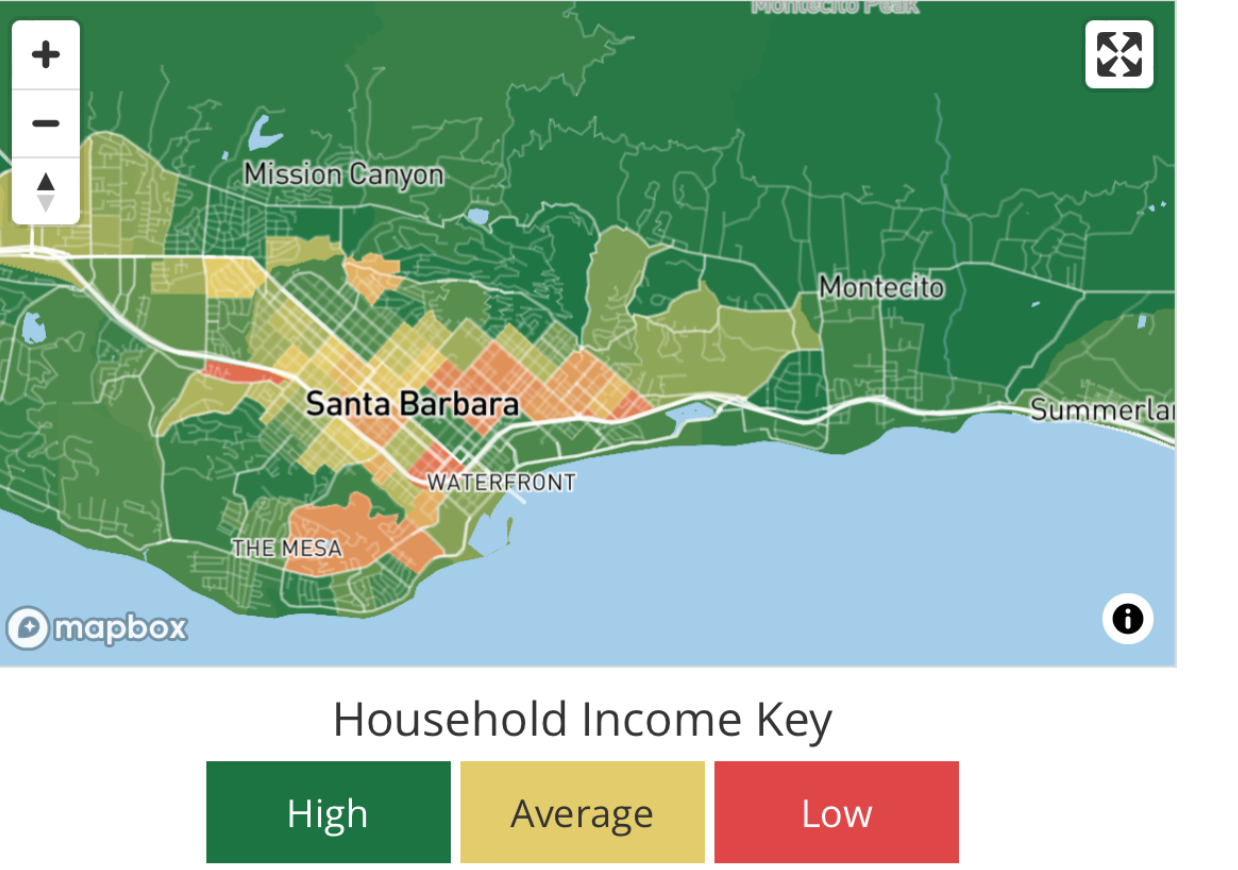
Courtesy of Best Neighborhood
However, the decision for this community to become a WFSAD protects more than just the wealthy. Vand said focusing on fire mitigation in the high fire zone protects the inner-city and downstream communities as well. Once ignited in the foothills, it is likely a fire will spread downhill to neighborhoods outside of the WFSAD.
Santa Barbara, like other cities in the American West, are well versed in wildfire management due to their “really deep, rich fire history,” according to Vand. Friedman urges other cities to get proactive about their fire management plans as well.
Acknowledging that the looming threat of losing FEMA funding is disheartening, he believes that local efforts must step up no matter what happens, because assessing vulnerabilities and risks on a hyperlocal scale is one of the foundations of effective fire management.
“...[vulnerabilities are] going to differ. Even within a couple of blocks. So the local expertise is going to be extremely valuable in creating the plans and also getting the word out to the public,” he said.
“You cannot rely on the government, but you can't do it without government either,” he said.
Sometimes that just means local government.