Boston Works Innovatively to Build Coastal Resilience around the City
Boston’s waterfront has risen 10 inches since the start of the industrial revolution and is projected to rise another two to four feet in the coming decades. Without coastal adaptation measures, entire neighborhoods will be submerged as soon as 2050.
To protect these neighborhoods, the City of Boston has implemented 4 Coastal Resilience Projects and is developing 12 others to mitigate the effects of climate change along the city’s coastline. While these projects were designed to address safety concerns related to accelerating sea level rise, their purpose is multi-faceted—providing both flood protection and community gathering spaces.
In Charlestown, Boston’s oldest neighborhood, the John J. Ryan Playground sits at a low point along the Mystic River, making it susceptible to flooding. As part of the Coastal Resilience Project, a berm is being installed to protect the park and surrounding communities from storm surge and sea level rise.
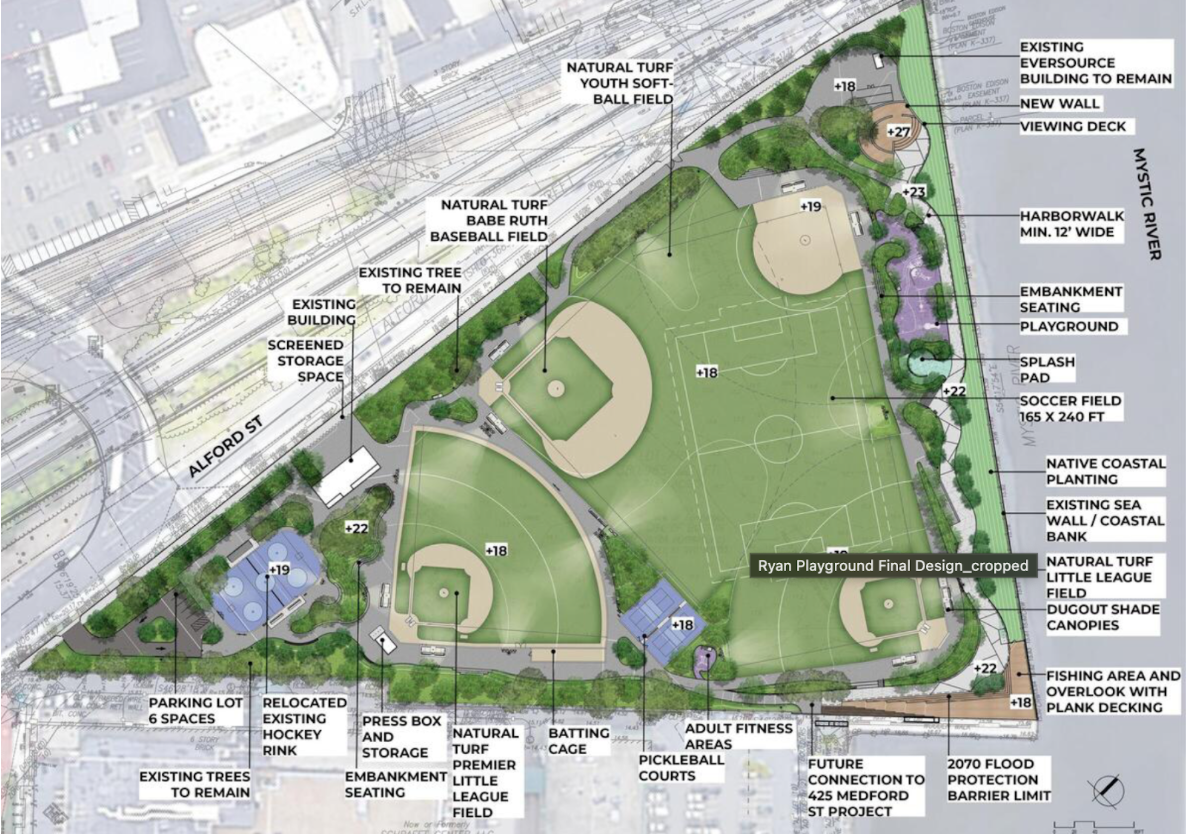
Rendering courtesy of Weston Sampson and Boston Parks and Recreation, accessed via the City of Boston website.
Along the spine of the berm, a waterfront path will string together several viewing decks and grassy plazas. Over 100 trees will be planted to create a canopy shade cover. Between the splash bed, a set of pickleball courts, several natural turf fields, a fishing area, and a hockey rink, there will be something for everyone to enjoy.
“Instead of just effectively blocking everyone’s view with the berm, we wanted to utilize it as a feature of a park,” B. Chatfield, senior project manager of the John J. Ryan Playground Improvement project, said.
Charlestown has one of the lowest ratios of open space per capita in Boston, according to a 2015 analysis by the City of Boston.
“Every square foot matters, and especially in an old city where you’re not growing the public realm. It’s really hard to come up with open space, with free space. You don’t want the berm to take over one of the ball fields,” said Chatfield.
In Boston, community is a byproduct of climate resilience. Addressing other city goals—ensuring equity, increasing walkable access to parks and promoting community connection—is a part of the Coastal Resilience Project.
“There are going to be spaces where you’re just gonna need to put a floodwall up and it’s gonna block views. But I think anyone who’s invested in the community for the long run will try their best to make a mural on the back of the floodwall,” said Chatfield.
Climate adaptation can have far-reaching benefits beyond safety from extreme weather. It is sometimes a matter of examining other municipal goals and determining if they can be addressed through climate resilience measures.
"Great local policy should always help address multiple issues at once,” according to Jack Hanson, executive director of Run on Climate.
“Our mission at Run On Climate is to help governments pass policies that create both immediate- and long-term benefits for communities."
Whether it’s something more technical like building a berm or planting native seeds in your garden, flood resilience is not new technology. Climate policy implementation does not necessarily require a whole new budget, rather rethinking the ways we can tackle multiple issues at once. Run On Climate is here to help you and your community in that effort.
*Reported on and co-authored by Amelia Digiano.