Moving the Dial on Environmental Equity with Renewable Energy Programs
“I remember the smell. And yet, I didn’t think anything of it.”
Janet Alexander Davis lives in Evanston, Illinois’ Fifth Ward, a predominantly Black neighborhood shaped by the lingering effects of redlining and decades of systemic disinvestment on the city's west side. Her family's roots in Evanston stretch back to the 1930s.
As a child, Davis rarely gave much thought to the neighborhood's waste transfer station. It wasn't until she became an environmental justice advocate that she began to see it differently.
“There was a garbage dump in the middle of a black neighborhood. It just kind of always shocked me that people were not aware,” she said, “This is really what's going on, folks, and not only here.”
Davis's experience is just one example of the kinds of inequities documented in Evanston’s Environmental Equity Investigation (EEI), which examined the generational impacts of environmental racism in Evanston and culminated in a report released in January, 2026.
According to the EEI, Davis's neighborhood is one of the areas facing the worst health outcomes. The report found that poor building conditions and energy inefficiency can expose residents to chronic illnesses, injuries, and greater vulnerability during extreme weather events. Together, these environmental inequities contribute to notable health disparities across Evanston, including a 13-year gap in life expectancy between census tracts.
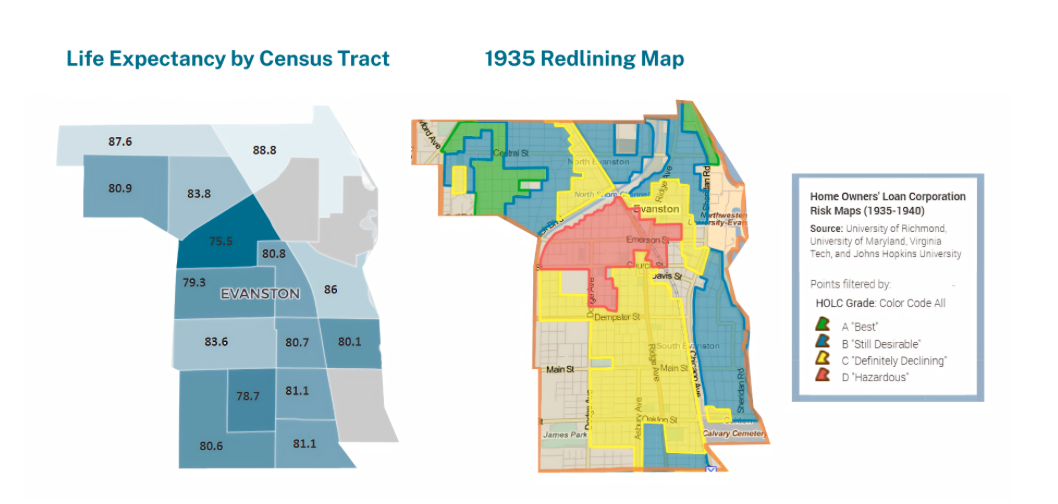
Life expectancy by census tract map and 1935 redlining map. Courtesy of Evanston Process for the Local Assessment of Needs, 2022.
Environmental Justice Evanston first called for the EEI in 2020. Four years later, the City Council approved the project, hiring consulting group MKSK Inc. to lead the 15-month investigation.
“[MKSK] did not shy away from taking a hard look at the disparities and the root causes, and coming up with not just a plan, but a set of recommendations for action,” co-chair of Environmental Justice Evanston, Jerri Garl, said.
Community engagement was central to the process. When the City approved the plan in July 2024, it appointed Davis as the head of the leadership committee. The committee met throughout the investigation to provide guidance, while focus groups, public workshops, pop-up events and an online survey gave residents opportunities to share their experiences and help shape the report's recommendations. Davis touched on the value of including as many voices as possible.
“You never know who you're going to meet, who's going to widen your perspective,” she said.
MKSK Inc. compiled the information received from residents, historical research, and existing city policies into its evaluation. The report identifies access to renewable energy as one way to address these longstanding disparities. A 2024 study found that greater access to renewable energy was associated with longer life expectancy. Yet the high upfront cost of home energy upgrades puts those benefits out of reach for many homeowners.
Evanston’s housing stock includes a large share of homes built before 1960, making them more susceptible to higher energy costs due to poor insulation and aging infrastructure. Renovations to mitigate health hazards can feel like a significant initial investment, according to perspectives shared in the EEI.
Despite the potential for long-term financial benefits through lower utility bills, the average cost of installing solar panels in Evanston is $37,036, creating a substantial upfront barrier for many residents in a city where the median household income is $96,434.
The report offered concrete fiscal recommendations, including targeted programs to help residents access rebates, technical assistance, and financing for energy-efficient home improvements.
"Develop programs and outreach that help property owners with electrification, energy efficiency, indoor air quality, and weatherization home upgrades," MKSK Inc. recommended in the final report.
This reinforced ongoing city initiatives like the Green Homes Pilot, a residential retrofit program that addresses health concerns such as mold, asbestos, and poor indoor air quality while lowering utility bills through energy-efficiency upgrades.
Cara Pratt, the City's chief sustainability and resilience officer, said the pilot program's implementation will conclude this summer after years of planning. Still, it has established a foundation for future efforts to expand access to renewable energy.
That work continues through the Evanston Sun Power program, which launched June 18. Funded by the U.S. Department of Energy, the initiative will provide rooftop solar installations at no cost to qualifying low- and moderate-income homeowners.
“The program reflects the City’s continued commitment to increasing community-wide renewable energy access and reducing harmful pollution from fossil fuels in living spaces and the atmosphere,” the City wrote in a press release.
“It's good that they're doing this. It's a very good way to actually establish priorities for the community, and it’s better for the long-term viability of any community as the climate continues to change,” Jesús Bravo, Solar Consultant for Windfree Solar, said. “It's important that people start seeing this as something that's important.”
Moreover, via collaboration with Elevate Energy, Windfree Solar, and Climate Action Evanston, the EEI report also offers recommendations that inform not only affordable energy programs, but reforms that would align with the City’s Climate Action and Resilience Plan.
"Priority setting and decision making, those are systems that lead to policy implementation," co-chair of Environmental Justice Evanston, Jerri Garl, said. "Having that resilience mindset is a policy framework that can be very, very influential.”
Looking ahead, Climate Action Evanston recently received a $25,000 grant from the Metropolitan Mayors' Caucus to support low-income energy-efficiency outreach beginning later this summer, an effort that further advances the report's outcomes.
Advocates say the success of the investigation will depend on whether those policies produce measurable improvements in communities that have historically faced the greatest environmental burdens.
"I like to ask, are the actions we're taking really moving the dial toward achieving our goals?" Garl said.
*Cover photo courtesy of Windfree Solar