
More Than Shade: How Burlington is using trees to build a more resilient city
BURLINGTON, Vt. — When people think about the infrastructure that keeps a city running, they usually picture roads, bridges, storm drains or power lines. Rarely do they think about trees.
As climate change brings hotter summers and heavier rainfall to Vermont, Burlington – the most populous city in the state – is increasingly treating its urban forest as critical infrastructure. Tree canopies cool neighborhoods, absorb stormwater, filter pollution and help cities adapt to a changing climate. But Burlington's newest tree canopy assessment found the city is losing the very resource it depends on.
Climate Change is Reshaping Burlington
According to data collected in Vermont’s Climate Assessment, Burlington’s average temperature has increased roughly 2 degrees Fahrenheit since 1960. Additionally, the city’s average annual precipitation has increased by nearly 21% since 1900, translating to an extra 6 inches of rainfall per year.
Higher temperatures have caused Burlington to experience flash droughts, causing rapid soil evaporation within a matter of weeks due to intense summer heat waves. However, when it does rain, the city experiences a “whiplash” trend, which increases the risk of summer flooding due to dry conditions.
These changing patterns are not abstract; they’re creating real infrastructure challenges.
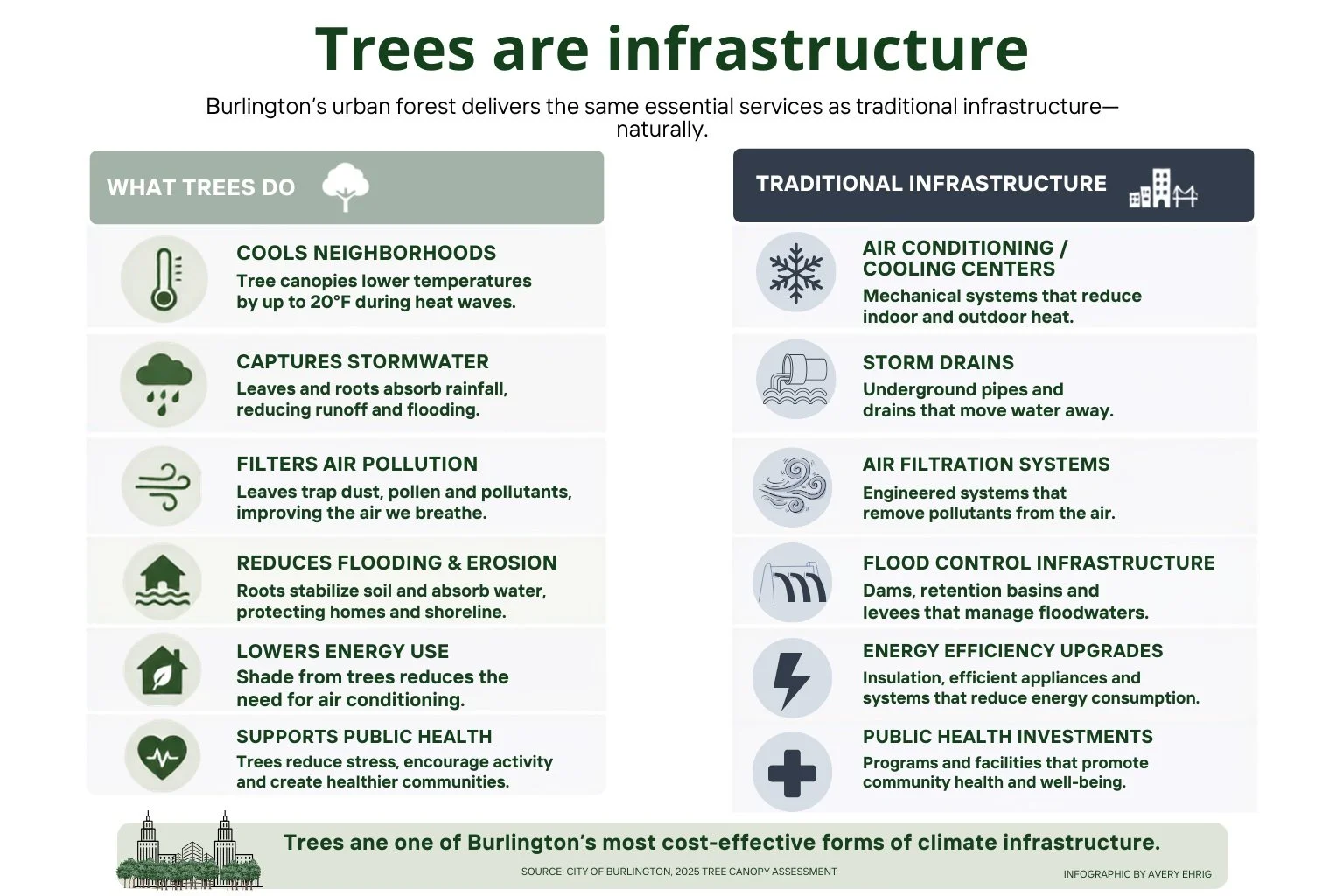
Unlike storm drains or cooling centers, which are designed to solve a single problem, city leaders see trees as one solution capable of addressing many of these climate challenges at once.
Why Trees have Become Climate Infrastructure
Burlington has made urban forestry a central part of its climate resilience strategy, treating trees as essential infrastructure alongside roads and stormwater systems.
Trees cool neighborhoods, absorb stormwater, improve air quality and reduce energy costs — services cities would otherwise have to provide through engineered infrastructure. During heat waves, shaded roads can be up to 20 degrees cooler, while tree canopies intercept rainfall before it reaches streets and storm drains.
Tree canopies also benefit the health of the general public. Not only do they cut air conditioning bills and boost property values, but they also lower stress levels for nearby residents.
Adam McCullough, urban forester with Vermont's Urban and Community Forestry Program said trees aren’t just landscaping — they’re investments.
“With all these benefits and a myriad of others not mentioned, clearly trees are worth the cost of maintenance and make cities livable," said McCullough.
Burlington is investing in trees
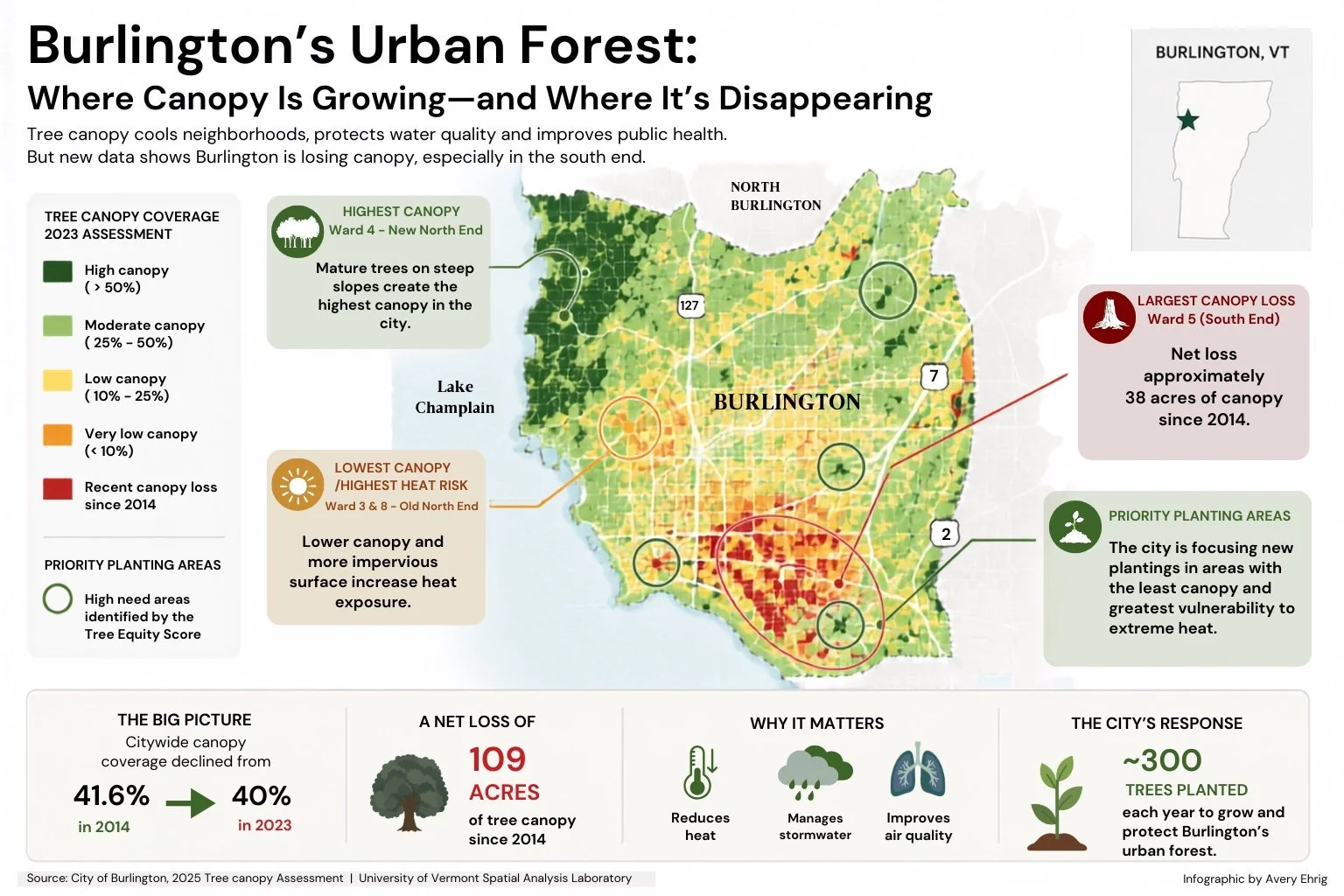
Recognizing those benefits, Burlington has woven urban forestry into its climate strategy. The city’s Climate Action Plan, Nature-Based Solutions Plan and its long-term Urban Forests Master Plan all prioritize expanding and protecting tree canopy to meet its net-zero goals, improve water quality and strengthen climate resilience. Together, the plans aim to plant about 300 trees each year while preserving the mature canopy already in place.
Burlington Council President Sarah Carpenter said the city backs those goals with dedicated staffing, including one of the few municipal arborists in Vermont.
"We're one of the few municipalities in Vermont that actually has an arborist on staff, so we spend a lot of resources protecting our trees and protecting our tree canopy,” said Carpenter.
Burlington’s investment expands beyond planting trees. The city’s development regulations require many new commercial and multifamily projects to preserve existing mature trees when possible, incorporate new shade trees into site designs and protect retained trees during construction through designated Tree Protection Zones. Existing trees can also count toward landscaping requirements, creating an incentive to preserve mature canopy rather than replace it after development.
The city also uses a Tree Equity Score to identify neighborhoods with the least canopy and greatest vulnerability to extreme heat, helping determine where new trees are planted first.
"Every year we invest in new trees, and it's [the arborist's] job to look and see where they're the most needed," Carpenter said.
Together, the plans aim to plant about 300 trees each year while protecting the mature canopy already in place through planning, development standards and long-term maintenance.
The Challenge
But despite years of planning and investment, the city's urban forest is moving in the opposite direction.
Paige Brochu, Director of the University of Vermont’s Spatial Analysis Laboratory said the city’s efforts are running into a problem.
"Canopy loss is an event, but canopy gain is a process,” said Brochu.
Since Burlington’s 2014 tree canopy assessment, coverage has declined nearly 1.6% despite ongoing city efforts. The city experienced a net loss of 109 acres of tree canopy, with south end neighborhoods of Ward 5 losing the most.
The assessment identified several overlapping factors that caused the city’s 109 acre drop, with one starting in residential neighborhoods.
Nearly 37.5% of Burlington’s tree canopy sits on privately owned land, meaning much of the tree loss came not from massive clear-cutting but from thousands of home owners removing trees in their own backyards for expansion or landscaping.
Moreover, new construction and real estate development in already dense areas like Old North End further sharpened the decline by requiring clearings of existing tree patches. The road and sidewalk configurations left very narrow green strips, making it difficult for mature street trees to survive or for new ones to be planted.
Lastly, the ongoing spread of invasive pests, most notably the Emerald Ash Borer, has forced the city to remove and replace threatened ash trees. Warmer winters driven by climate change reduce the freeze mortality rates that previously kept invasive pests in check.
These changing weather patterns in turn make mature trees much weaker and less resilient to pest attacks. Insects and rising temperatures have quickly overtaken traditional forces as the leading drivers of tree mortality in Northeastern forests.
“A mature tree can be removed in an afternoon, but its replacement takes decades to deliver the same shade, stormwater capture and cooling,” said Brochu.
Why mature trees matter
Mature trees provide benefits that young saplings cannot match for decades. Their larger canopies store more carbon, filter more air pollution, reduce flooding through extensive root systems and provide significantly more cooling during heat waves.
"The goal should be to grow big trees. There's a general rule that the largest 20% of urban trees give us 80% of the tree benefits in a community,” said McCullough.
Mature tree canopies cool neighborhoods exponentially better by casting large, dense shadows and releasing massive amounts of moisture.
Saplings lack the leaf volume to make a measurable dent in city heat, whereas a network of mature canopies can lower an entire neighborhood’s temperature by several degrees.
"Even if a town has a policy to plant one tree for every tree they cut down, they will be losing canopy,” said McCullough.
Climate resilience isn’t simply about planting more trees. It’s protecting the ones that are already standing.
"The decline is reversible, but only with deliberate preservation of the mature trees already standing, paired with sustained replanting,” said Brochu.
As Burlington prepares for a warmer and wetter future, protecting the city's urban forest may prove just as important as expanding it.
"Urban forestry is the art and science of restoring the ecological functions that we lost,” said McCullough.
*Cover Image Depicts Burlington, Vermont, Courtesy of Wikimedia Commons