
When pollution couldn’t be considered: How LA County approved five industrial projects without environmental review
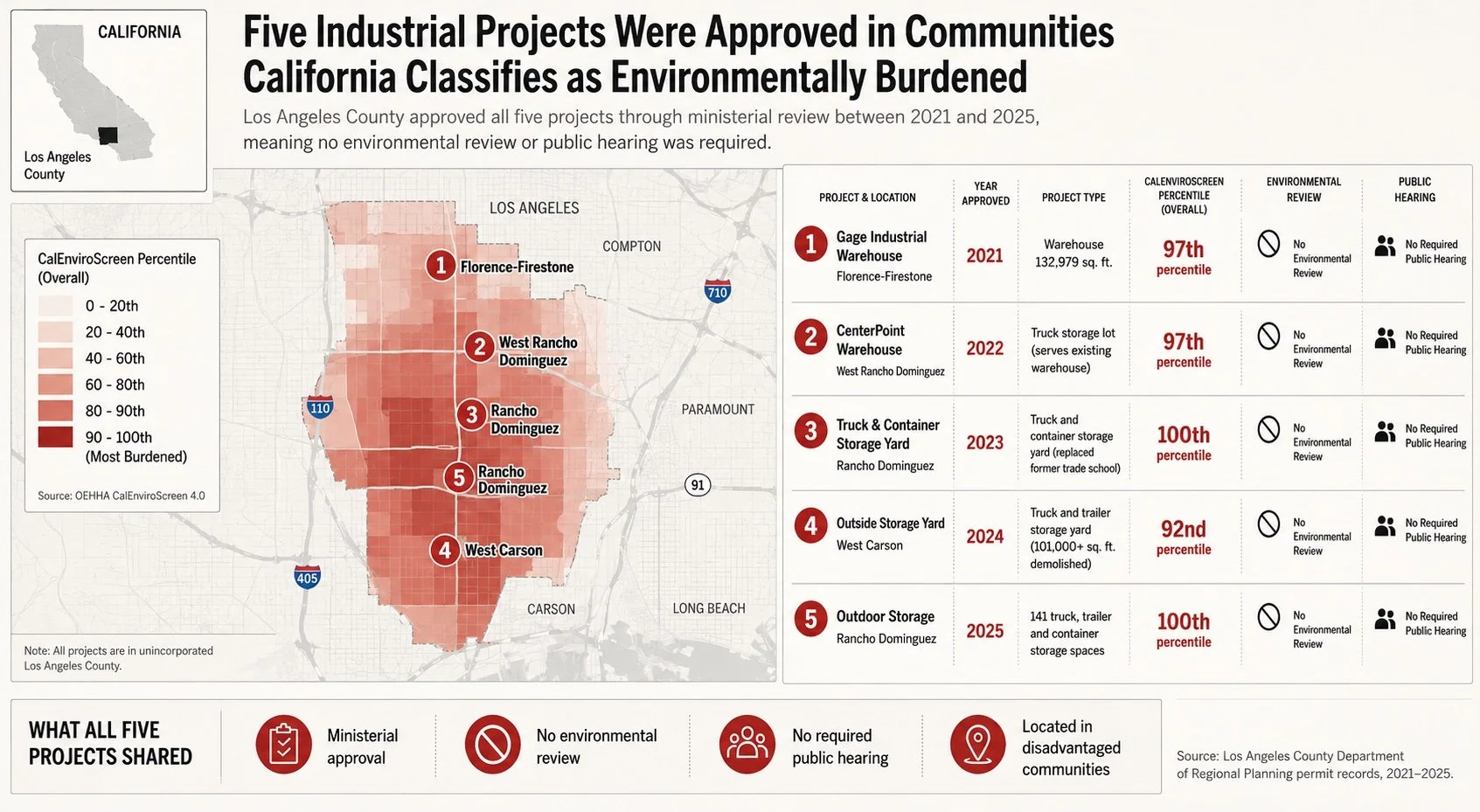
LOS ANGELES, Calif. — Five times in four years, Los Angeles County approved new warehouses and truck storage facilities in some of California's most polluted neighborhoods. Five times between 2021 and 2025, the projects moved forward without environmental review or a required public hearing.
The first domino fell in August 2021, when county planners approved the nearly 133,000-square-foot Gage Industrial Warehouse Project in Florence-Firestone, a community that ranks in the 97th percentile statewide for pollution burden.
"Community members likely had no idea about the project until it was under construction because noticing wasn't required back then,” said Jonathan Pacheco Bell, a practicing urban planner in Los Angeles County and board member of the Florence-Firestone Community Organization.
County planning documents identify these same neighborhoods as disadvantaged communities and set goals to reduce pollution burdens. Yet planners say state law prevented them from considering those burdens when approving the projects.
A process without environmental review
California’s Environmental Quality Act (CEQA) is a fundamental California law that requires state and local agencies to identify and assess the significant environmental impacts of proposed projects before final authorization.
Under CEQA, projects generally fall into two categories: discretionary and ministerial. Discretionary projects allow planners to exercise judgment, require environmental review, and often include public hearings. Ministerial projects are different. If a proposal complies with existing zoning rules, planners have little to no discretion and must approve it.
Diana Gonzalez, principal planner of operations and major projects for LA County's Department of Regional Planning, said the five projects qualified for ministerial approval because they complied with existing zoning regulations.
"The statutory exemption is absolute and no other analysis is required,” said Gonzalez.
Pacheco Bell mentioned “This is the key difference between by-right, or ministerial, land use approval versus discretionary approval requiring public hearings.”
Put simply, planners reviewing ministerial projects are checking whether a proposal complies with zoning rules — not whether it is appropriate for the surrounding community.
California's CalEnviroScreen identifies communities disproportionately burdened by pollution. Yet Gonzalez said planners could not legally use those scores when reviewing ministerial projects.
"Staff cannot utilize the CalEnviroScreen data and or conduct any cumulative analysis because there are no exceptions applicable to a CEQA statutory exemption,” said Gonzalez.
Considering CalEnviroScreen data would require planners to exercise discretion, something ministerial approvals are designed to avoid.
Why these projects qualified
Florence-Firestone, Rancho Dominguez and West Carson are unincorporated communities governed directly by Los Angeles County rather than individual city governments, meaning land-use decisions are made by the county instead of a local city council or planning department.
Gonzalez said most of these zones are located in Employment Protection Districts — areas reserved for the specific use of industrial and commercial development.
"If a project is not discretionary and instead it's ministerial, we are limited to the regulations in Title 22," said Gonzalez.
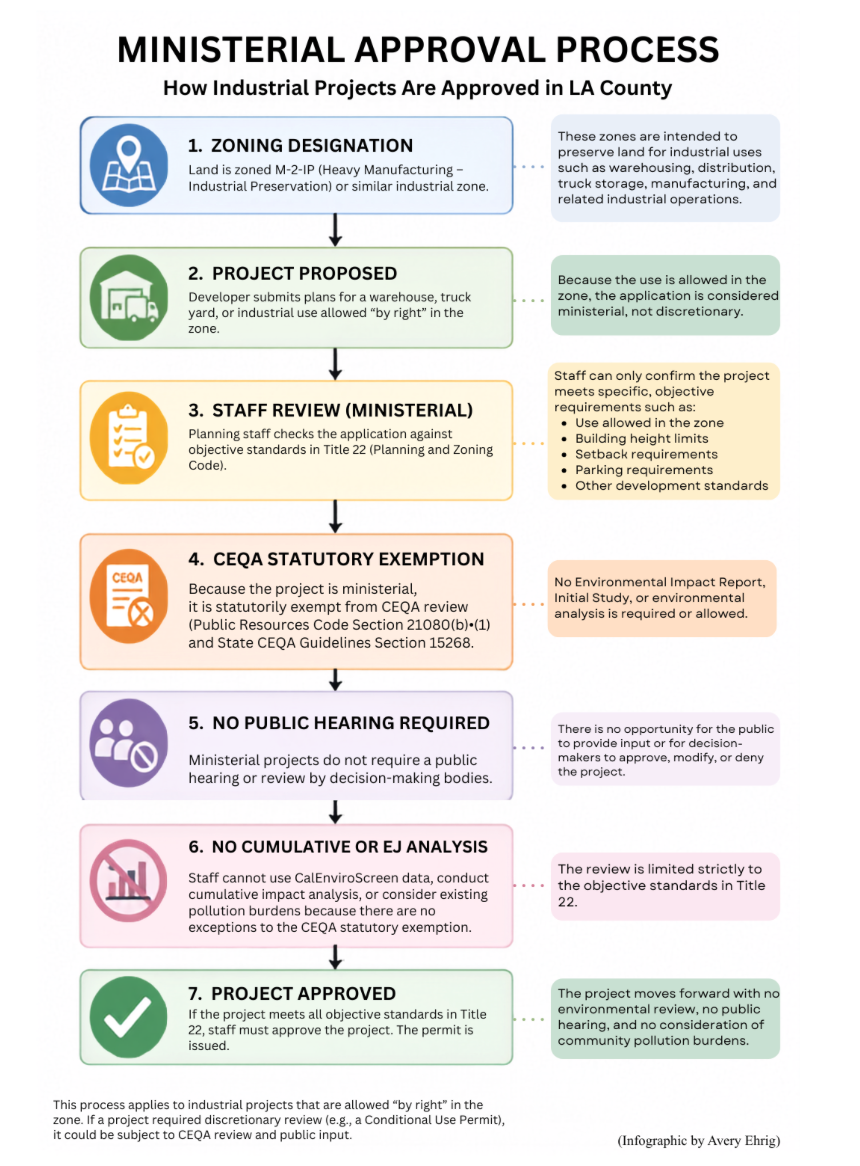
LA County planners were not deciding whether the projects were environmentally appropriate; they were determining whether the projects complied with existing zoning rules.
Five projects, one pattern
The Gage project was not an isolated decision. Between 2021 and 2025, Los Angeles County approved four additional industrial projects through the same ministerial process.
In 2022, the CenterPoint Warehouse project replaced two industrial buildings with a truck storage lot in West Rancho Dominguez. A year later, a truck and container storage yard replaced a former trade school in Rancho Dominguez.
In 2024, county planners approved another truck and trailer storage yard in West Carson after more than 101,000 square feet of industrial buildings were demolished. By December, 2025, a fifth approval authorized 141 truck, trailer and container storage spaces in Rancho Dominguez.
The approvals also raised questions about cumulative impacts. Because each project qualified individually as ministerial, none triggered an environmental review of their combined effects.
Every project sits in a community where diesel pollution and hazardous waste already rank the highest percentiles in the state. Each neighborhood is identified by the state as among California’s most environmentally burdened communities, yet LA County determined no environmental review was necessary.
Courtesy of Avery Ehrig
What happened after Gage?
As Pacheco Bell mentioned, the Gage Industrial Warehouse Project was approved under zoning rules that no longer apply in Florence-Firestone.
At the time, the property was zoned M-1 Manufacturing, where warehouses were permitted by right through a ministerial review process.
"If this warehouse project were to be proposed today, the project would require a Conditional Use Permit which includes a public hearing," Pacheco Bell said.
Pacheco Bell said the neighborhood has since been rezoned under the Florence-Firestone Transit Oriented District Specific Plan. Under the updated zoning, warehouses proposed within 500 feet of homes, schools or other sensitive uses generally require a Conditional Use Permit, triggering a public hearing and allowing planners to conduct environmental review when required.
He also pointed to the county's Green Zones program, adopted after the Gage approval, as another step toward strengthening public participation and environmental protections for industrial development near residential neighborhoods.
Pacheco Bell said these changes give residents a voice they didn't have in 2021.
Environmental justice meets environmental review
LA County’s Sustainability Plan sets a measurable goal of reducing toxicity-weighed emissions in disadvantaged communities by 80% by 2045.
According to county documents, the goal explicitly states “The County will protect low-income communities and communities of color from pollution.”
The Green Zones Program "Supports the goals and the implementation of environmental justice throughout the unincorporated areas by identifying communities that disproportionately bear a burden from stationary sources of pollution due to incompatible land uses.”
Together, the county's planning documents illustrate a tension between long-term environmental justice goals and the regulations governing ministerial approvals. While the county has committed to reducing pollution in overburdened communities, those communities operate separately from the zoning rules that govern by-right developments.
The county’s response
County officials maintain that the projects complied with existing zoning regulations and state law. Gonzalez said the environmental impacts of industrial land uses were evaluated during Los Angeles County’s 2015 General Plan update, rather than during the approval of individual ministerial projects.
According to the county, ministerial approvals are governed by Title 22 zoning regulations, leaving planners without the legal authority to require additional environmental review for projects that comply with existing zoning.
Some of the rules that allowed the Gage Warehouse to move forward have since changed. Florence-Firestone’s updated zoning and the county’s Green Zones program now require greater public participation for certain industrial projects proposed near homes and schools.
While county planners say the law limited what they could consider during the approval process, residents continue to live alongside the industrial corridors those rules govern. For Pacheco Bell, improving planning is about more than updating policies — it requires a stronger presence in the communities most affected.
"We would love to see the County regional planners physically here in the community more," Pacheco Bell said. "They should be here with us."
Whether those reforms will fully align the county’s environmental justice goals with the permitting process remains an open question.